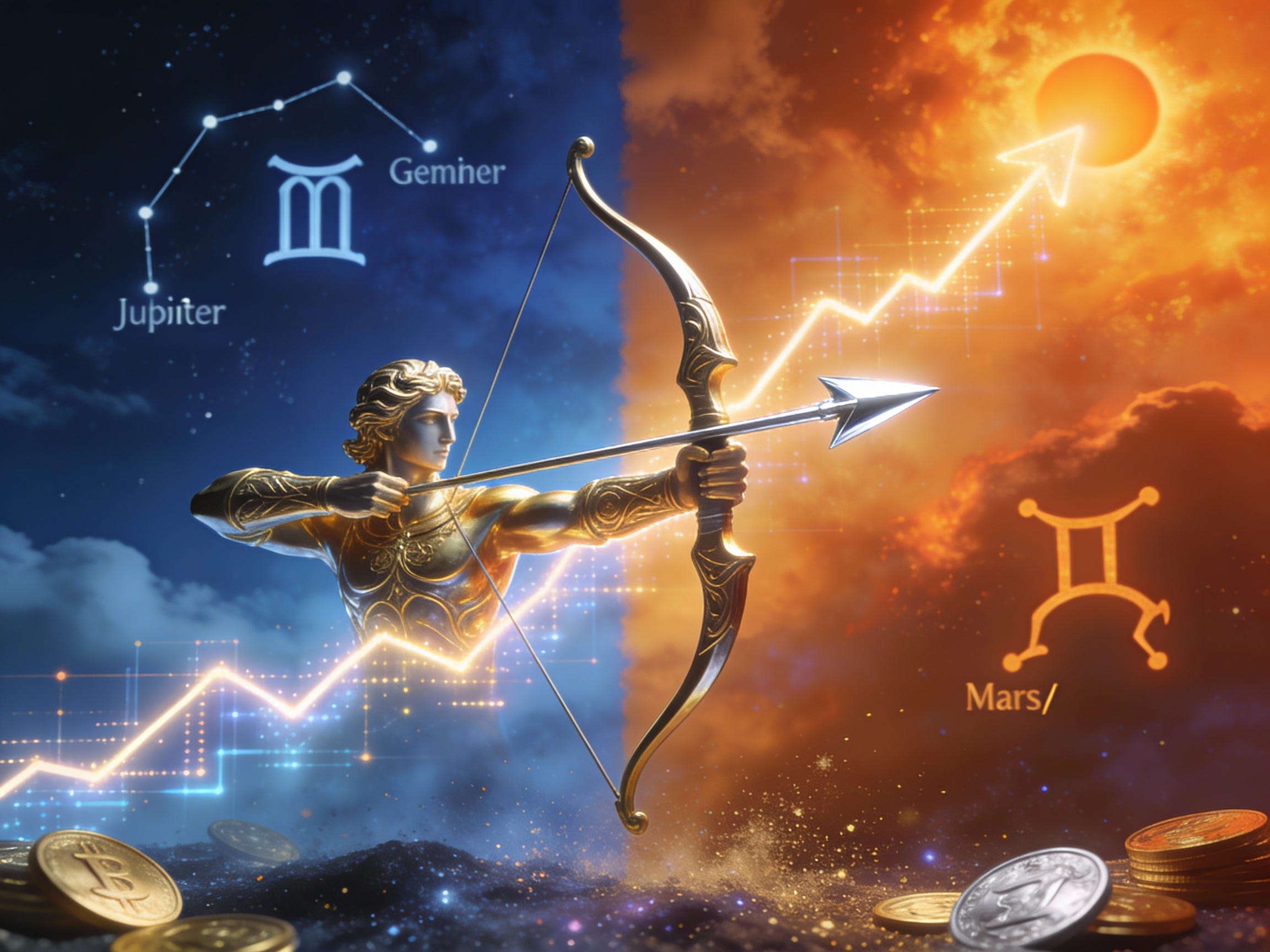
Dhanu Sankranti 2025 Market Shift: From Tight Coils To Breakout Energy – Gold And Silver Playbook For Dec 16 – Jan 14
This Dhanu Sankranti window is not a quiet consolidation phase. It is a classic coil-release period where Jupiter rewinds back into Gemini, fire builds in Sagittarius, and both gold and silver can see sharp, tradable swings rather than a slow drift.
This article uses Vedic astrology as a timing framework for market psychology. It is for educational and entertainment purposes only, not financial advice. Always consult your financial advisor before trading.
One-line energy summary
From 16 December to 14 January, the sky is dominated by Sagittarius fire and a freshly re-entered Jupiter in Gemini, pointing to volatility first and then directional moves in both gold and silver.
For gold, this looks more like a choppy, news-sensitive phase with spikes around geopolitical or central-bank headlines.
For silver, the same configuration tends to amplify moves and reward aggressive traders more than passive holders.
The pivot: Dhanu Sankranti and key dates
Dhanu Sankranti is the Sun’s entry into sidereal Sagittarius, the sign of expansion, belief systems and big-picture bets. For this cycle, the key trigger dates are:
5 December: Jupiter re-enters Gemini (retrograde), re-activating the “information, rumours and speculation” axis.
7 December – 15 January: Mars in Sagittarius, adding heat and speed to every move.
15 December – 14 January: Sun in Sagittarius, the actual Dhanu window.
19 December: New Moon in Sagittarius, a fresh “reset candle” for this whole cycle.
19 December – 12 January: Venus in Sagittarius.
28 December: Mercury enters Sagittarius.
In plain English, this is a month where fire signs dominate and almost every inner planet piles into Sagittarius at some point. That is not “mean reversion” energy. It is “trend followed by overshoot and then exhaustion” energy.
How this maps to Vyapar Ratna rules
From the Vyapar Ratna rulebook:
Gold up bias when:
Jupiter is retrograde (up and down but finally up).
Venus is strong in a fire sign like Leo (similar logic carries into Sagittarius as a dharma fire sign).
Gold down bias when:
The Sun passes through Anuradha and related Scorpio nakshatras, or when Jupiter is rising direct and risk-on sentiment takes over.
Silver up bias when:
Jupiter retrograde or Mercury retrograde is active, with a “volatile then finally up” pattern.
The Sun is in Pushya or Dhanishtha, or when there is a strong fire and air mix that boosts industrial and speculative demand.
Silver down bias when:
Jupiter turns direct.
Mars is combust, or big fire energy flips from trending to exhaustion.
For this Dhanu Sankranti period itself (16 December – 14 January), Jupiter is still retrograde in Gemini, so the “up/down then up” rule remains active for both metals. Mars is not yet out of combustion until the second week of January, which keeps a cap on the clean upside for silver and adds noise. The Sag pile-up is therefore best read as “preparation phase plus first breakout attempts,” not the final leg of the move.
Gold bias: choppy bullish with event spikes
Gold has a mild bullish bias, but the structure is more choppy than trending between 16 December and 14 January.
Jupiter retrograde remains a supporting factor for gold as a wealth-preservation asset, but Gemini is an air sign, so flows can be headline-driven and short-lived.
Sun, Mars, Venus and later Mercury in Sagittarius favour “big-theory” trades, so gold is likely to move on macro stories such as rate-cut expectations and political risk rather than quiet accumulation.
For traders, that translates into:
Expect higher intraday ranges and more fake breakouts around the New Moon on 19 December.
Use strength into news events to lighten risk rather than chase, unless your stop-loss discipline is very tight.
Silver bias: volatility with an upside lean
Silver remains the higher-beta trade in this window, with Jupiter retrograde in an air sign favouring sharp swings that gradually resolve higher.
The same Vyapar Ratna rule that helped explain silver’s 2025 outperformance is still active: Jupiter retrograde, especially in a sign linked to trade and information, tends to generate volatility followed by a positive resolution.
However, Mars is still combust for part of this stretch, and Vyapar Ratna explicitly treats Mars combustion as a “silver down” or at least “silver pressure” factor, which can translate into shakeouts before the next leg higher.
Practically:
Silver dips caused by fast liquidation or margin selling are more attractive than gold dips in this period.
The risk is that silver overdoes both sides: rapid spikes on good news and equally sharp flushes on position unwinds.
Action playbook by risk appetite
This is not personalised advice, just a way to translate the astro-map into concrete behaviour.
Conservative investors
Maintain core gold exposure as a hedge, but do not dramatically increase allocations within this window.
Add silver only on clear technical pullbacks rather than on vertical breakouts.
Keep position sizes small relative to equity or cash.
Active swing traders
Treat 19 December (New Moon in Sagittarius) and the last week of December as “signal zones” where the next 4–6 week trend tries to establish.
Focus on mean-reversion trades early in the period, shifting to breakout or trend-following only if price holds above prior resistance into early January.
For silver, consider scaling in on intraday panic moves rather than overnight jumps.
High-risk speculators
This is a favourable window if you actively seek volatility and can sit in front of screens.
Consider pairing trades: long silver against gold when silver is underperforming intraday, then flatten into parity moves.
Watch for signs of exhaustion in the last few days before 14 January as the Sun prepares to exit Sagittarius.
Key levels and dates to watch
While exact price levels depend on your data feed and timeframe, the dates are clear:
Around 19 December: New Moon in Sagittarius, often a psychological reset point where metals can briefly overshoot and then reverse.
Year-end trading days: liquidity thins, so any Jupiter retrograde-driven rumours can cause exaggerated moves.
10–14 January: final days of Mars-in-Sagittarius plus Sun’s last stretch in Sagittarius, often a time when the existing trend either accelerates or fails.
If gold and silver are both pushing new local highs into the second week of January without strong volume, treat that as a caution signal rather than a green light to double size.
Risk radar for this Dhanu cycle
Event risk: sudden geopolitical or policy headlines can magnify what is already a fire-sign-dominated sky.
Liquidity risk: year-end books, tax selling and reduced dealer inventory can widen bid-ask spreads.
Overconfidence risk: a strong 2025 for precious metals can make traders assume “it will keep going” without respecting Jupiter retrograde’s up/down structure.
Timing risk: key confirmation and invalidation points sit just outside this window, especially Mars clearing combustion and Jupiter eventually turning direct later on.
Bottom line and CTA
Between 16 December and 14 January, Dhanu Sankranti hosts a sky that favours volatility, narrative-driven moves and tactical positioning rather than blind buy-and-hold in gold and silver. For investors, the safer stance is to respect existing bullish structures but wait for cleaner signals into mid to late January before sizing up. For traders, this window is rich with opportunity, provided stops and position sizing are treated as non-negotiable.
If you want, the next step could be a focused note just on the second half of January: Mars clearing combustion, Sun into Capricorn and how that typically changes the tone for precious metals.


