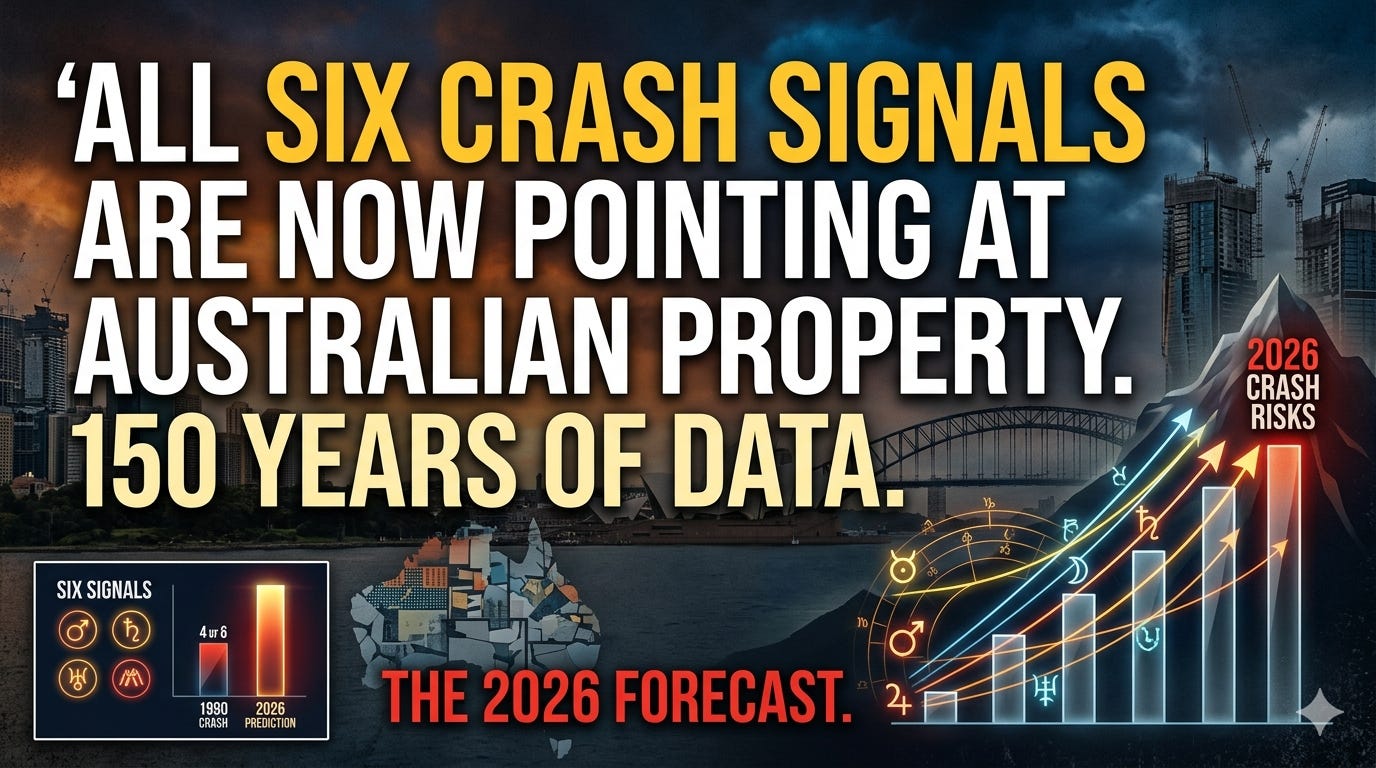
Six Crash Signals. 150 Years of Data. All Six Are Now Pointing at Australian Property
A few weeks back I ran a full pattern comparison. 150 years of Australian housing history mapped against planetary cycles tracked through Swiss Ephemeris data.
Melbourne fell 51% in the 1890s. Sydney dropped 36% in the same period. The 1990 crash wiped 20% in real terms. That one gave us the “recession we had to have.”
Each of those crashes had a fingerprint. A set of conditions that showed up together. Over 150 years I found six recurring signals. The 1990 crash, the worst in modern Australian history, matched four of them.
Right now, going into 2026, all six are active simultaneously.
That has not happened before. Not once in 150 years of data.
I want to be straight with you about what this is and what it is not. This is planetary cycle analysis applied to market timing. It does not predict exact prices or guarantee outcomes. What it does is flag when historical stress conditions are repeating, and by how much. Right now the reading is unusually consistent across every signal we track.
What’s Inside:
The six warning signals, explained in plain terms
Why 2026 looks like a blow-off top rather than a stable market
The specific windows when risk peaks
What could soften the fall
How This Analysis Works
I mapped 150 years of Australian property crashes against planetary cycles. The key planets involved are Saturn (associated with debt, credit structures, and financial regulation), Jupiter (associated with optimism and market peaks), and the lunar nodes Rahu and Ketu (which mark structural sentiment shifts).
Each major crash left a cluster of these conditions active at the same time. I extracted six recurring signatures from the worst downturns. The more signatures that align at once, the more severe the historical outcome.
Here is how the major crashes scored against these six signals:
The 1890s crash scored 1 out of 6. Melbourne fell 51%, Sydney 36%. The 1930s scored 1 out of 6. The 1950s scored 1 out of 6. The 1974 downturn scored 1 out of 6. The 1990 crash scored 4 out of 6 and produced roughly 20% real decline.
The 2026 to 2027 window scores 6 out of 6.
The Six Warning Signals
Signal 1: Hidden debt surfaces (Saturn-Neptune alignment in Pisces)
Every time Saturn and Neptune have aligned within 5 degrees in the sky, a significant credit stress cycle has followed in Australian real estate. The 1952 alignment produced a 28% housing decline. The 1989 alignment produced the 20% real decline and the “recession we had to have.”
The exact alignment this cycle occurred around February 2026. As of April 2026, Saturn sits at 13 degrees Pisces and Neptune at 8 degrees Pisces, approximately 5 degrees apart.
What makes this version different is that Neptune rules Pisces, the sign the alignment is occurring in. That makes this the strongest version of this signal in modern data. Hidden debt, stretched mortgages, and credit stress that does not yet show in headline numbers tend to surface when this signal fires.
Signal 2: The blow-off top (Jupiter moving into Cancer)
When Jupiter enters Cancer, where it performs at its historical strongest, Australian property has consistently seen a sharp final surge in prices followed by an equally sharp reversal. This happened in 1988 to 1989, directly before the 1990 crash.
Jupiter enters Cancer again around June 2026 and peaks through November 2026. This is the window where FOMO buying typically intensifies, auction clearance rates look strong, and the media narrative settles on “property always goes up.” The pattern says this phase ends badly.
Signal 3: The sentiment shift (Rahu moves to Capricorn, Ketu moves to Cancer in January 2027)
The lunar nodes, Rahu and Ketu, shift axis roughly every 18 months and mark structural changes in collective behaviour around specific sectors. When this axis aligns across the Capricorn-Cancer line, Australian property sentiment has historically undergone a hard reset. It happened in 1989 to 1990.
In January 2027, Rahu moves into Capricorn and Ketu moves into Cancer. This time, Pluto has been sitting in Capricorn since 2020. Rahu and Pluto aligning in Capricorn simultaneously is a configuration with no direct modern parallel. The structural disruption potential around property ownership is significantly higher than in prior cycles.
Signal 4: The sharpest single-month trigger (Mars in Cancer opposite Pluto in Capricorn)
Mars in Cancer is in a weakened position in this system. When it faces off against Pluto in Capricorn at close range, the pattern shows sudden reversals in construction, land, and credit markets.
This exact configuration fires in October 2026 at a 1-degree orb, the tightest and most acute version of this signal. It repeats during a retrograde pass in April 2027. October 2026 is the single sharpest reversal window in the entire sequence.
Signal 5: Financial regulation breaks down (Saturn enters Aries in May 2027)
Saturn in Aries is in its weakest position. Saturn governs banks, lending frameworks, and financial regulation. When it is in Aries, the historical pattern shows impulsive and poorly structured financial decisions replacing disciplined controls. The 1974 downturn featured Saturn in a similarly weakened state. Saturn enters Aries around May 2027, in the middle of the Rahu-Pluto-Ketu configuration described above. There is no comparable stabilising factor present this time.
Signal 6: The eclipse trigger (Lunar eclipse in Magha, August 2026)
In 1989 and again in 2007, a lunar eclipse in the Magha nakshatra, a lunar mansion historically associated with property and ancestral land, marked the inflection point between the final price surge and the beginning of the decline. The next such eclipse falls in August 2026, directly inside the Jupiter-Cancer blow-off top phase.
The Five Phases: What to Watch and When
This is not a single event. It plays out across five overlapping phases.
April to June 2026 (Setup)
On the surface, nothing looks alarming. Prices may appear stable or slightly positive. The RBA may be pausing rate moves or cutting. But debt is accumulating in ways that will not show in headline data yet. This is the quiet phase before the noise starts.
July to October 2026 (Blow-off top)
This is the most dangerous phase for new buyers. Property prices surge. Media coverage gets bullish. Auction clearance rates are high. This looks like confirmation that conditions are strong. The August 2026 eclipse is the hidden inflection point sitting inside this phase. The pattern says this is the peak, not a new floor.
October to December 2026 (The turn)
The Mars-Pluto opposition fires at 1-degree orb in October 2026. Monthly price data begins turning negative. Auction clearance rates drop. Jupiter moves from Cancer to Leo before December, removing the optimism floor that held prices up through the previous phase.
January to April 2027 (Acceleration)
Rahu shifts to Capricorn and Ketu shifts to Cancer in January 2027. Jupiter turns retrograde back into Cancer in early 2027. By April 2027, three planets are simultaneously in Cancer in weakened or retrograde positions: Ketu, Mars retrograde and debilitated, and Jupiter retrograde. The “safe as houses” narrative begins breaking publicly across media, policy, and market data.
May to September 2027 (Maximum pressure)
Saturn enters Aries debilitated around May 2027. Forced selling, distressed auctions, and credit market stress are the pattern signals for this phase. Rahu and Pluto are both in Capricorn. This is where the steepest monthly declines historically appear, and where potential credit events become possible.
How Bad Could It Get?
Based on the historical match scores, here are the four scenarios the data supports:
Mild outcome (15% probability): RBA policy response absorbs the shock. 5 to 8% nominal decline. Closest parallel is Australia in 2008, when Jupiter in its own sign provided a temporary floor.
Moderate outcome (40% probability): 15 to 20% real decline. Direct 1990 echo. The same conditions that produced the “recession we had to have” are repeating, with a higher signal count.
Severe outcome (35% probability): 20 to 30% real decline. No single modern parallel. The closest match is a combined reading from the 1950s decline of 28% and the 1990 decline.
Depression-scale outcome (10% probability): Would require a banking system failure combined with a global recession trigger firing simultaneously.
Base case: 15 to 25% real decline in Australian residential property, concentrated between October 2026 and September 2027.
Sydney and Melbourne carry the highest risk, given high debt-to-income ratios and investor concentration. WA and QLD may hold up longer through the Jupiter-exalted phase into late 2026, supported by commodity-related income, before turning during Phase 5.
Regional and coastal markets that surged post-COVID face the greatest nominal risk.
What Could Soften the Fall
This is not a one-sided picture. A few factors push back against the bearish signals.
Jupiter in Cancer runs through November 2026 and provides a 4 to 6 month buffer. Sharp falls before October 2026 are unlikely based on pattern history. The RBA still has room to cut rates and deploy first-home buyer support, the same tools used in 2008. Structural undersupply in Sydney and Melbourne provides a demand floor that did not exist in the 1890s or 1930s. The global environment through mid-2026 is broadly supportive of growth assets.
The key point the data makes is this: mitigating factors can delay and soften the cycle, but nothing in the current configuration cancels a pattern this strong.
Try This:
If you hold property in Sydney or Melbourne, review your fixed versus variable rate exposure before October 2026. That is the window where the first visible data shift in clearance rates is most likely to appear based on this analysis. You do not need to act now. But you do want to know where your numbers stand before the monthly data starts turning.
Are you already seeing the FOMO buying in your local market, or does it still feel cautious where you are? Hit reply. I read all of them.
If this kind of analysis is useful to you, consider subscribing. Free articles give you the big picture direction. Paid gives you the specific timing windows, price levels, and entry and exit zones across all the asset classes we cover.
Stay grounded,
AstroVedicTime