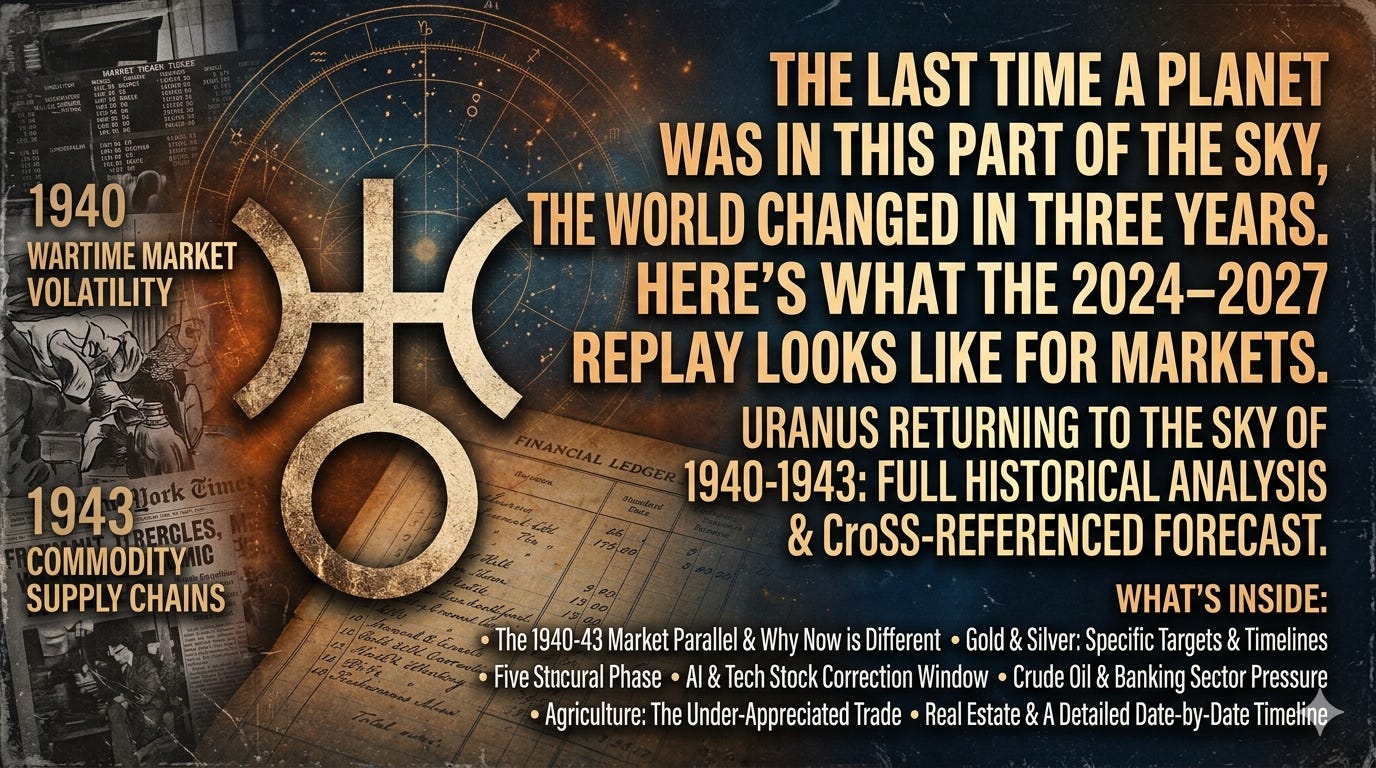
The Last Time a Planet Was in This Part of the Sky, the World Changed in Three Years
I’ve been sitting on this analysis for a while because it needed to be done properly. Not a quick chart read. A full historical comparison, cross-referenced against three other forecasts I’ve published this year, with planetary data verified through Swiss Ephemeris calculations.
What I found is one of the more striking parallels I’ve come across in years of doing this work. The last time Uranus moved through the same zone of sky it currently occupies, the years were 1940 to 1943. The context was World War II, commodity supply chains physically burning, and institutions collapsing under the weight of events nobody had planned for.
Before you close the tab thinking this is a doomsday read, stay with me. The comparison is more specific than that, and the key point is actually about why this time is structurally different, not the same. Understanding both sides of the picture is what makes this useful for positioning your money over the next 18 months.
This is a long one. Worth the read.
What’s Inside:
What the 1940-43 period actually looked like in markets
Five reasons the 2024-27 setup is different in structure
Gold and silver: targets and the timeline for each leg
Bitcoin: the ATH run, the 2026 correction, and the 2027 institutional phase
AI and tech stocks: where the overvaluation sits and when it corrects
Crude oil: why it spikes but can’t sustain
Banking: which part of the sector is under the most pressure
Agriculture: the most under-appreciated trade of this entire cycle
Real estate: what holds and what doesn’t
A full date-by-date timeline from now to late 2027
What Actually Happened in 1940-1943
In Vedic sky mapping, the zone called Krittika sits at the edge of Taurus. It is ruled by the Sun, making it directly connected to gold, material wealth, and physical security. When a major slow-moving planet crosses through here, it tends to shake up whatever those things represent in the current era.
In 1942, Uranus entered this zone. At the same time, Saturn was in a seriously weakened state, having been in debilitation (its weakest placement) for the two years prior. By January 1942, Saturn was at 29 degrees Aries, essentially the last breath of that debilitated placement, right on the edge of Taurus. Uranus was at roughly 3.45 degrees into Taurus, already inside Krittika.
The result was two major slow planets grinding against each other in the same narrow zone of the sky while one of them was severely weakened. In market terms: commodity supply chains physically destroyed, gold and oil prices spiked under government controls, and institutions that had held together for decades collapsed under the pressure of total war.
The recovery came when Jupiter entered Cancer in mid-1943, its strongest placement. From that point, the rebuilding phase began. Allied resurgence. Agricultural output recovering. Post-Stalingrad trajectory reversal.
That 1943 recovery signal is the most important parallel for what’s coming in 2026. More on that below.
Five Reasons the Current Setup Is Structurally Different
This is not a replay of 1942. The themes are similar but the intensity and nature of disruption are completely different. Here’s why.
First: Saturn is in a healthy position this time. In 1940-42, Saturn was debilitated in Aries for nearly two full years before entering Taurus. Debilitated Saturn means discipline collapses, aggression without structure, institutions failing to hold the line. Right now, Saturn is in Pisces, a neutral placement where it governs shipping lanes, hidden debt, maritime trade, and regulatory systems. Disruptions route through those channels rather than through physical destruction.
Second: Saturn and Uranus are cooperating, not colliding. In 1942, the two planets met in near-conjunction while Saturn was at its weakest. Right now, they are in a sextile relationship (roughly 60 degrees apart), with the tightest alignment around March 2025 at 0.38 degrees and January 2026 at 1.74 degrees. A sextile means the two planets are working through friction rather than grinding against each other. The outcome is reform under pressure, not collapse.
Third: The amplifier is rotating. In 1943, Jupiter moved directly into its strongest placement (Cancer exaltation) all at once, delivering a concentrated recovery signal. This time, Jupiter is rotating through multiple signs in sequence: Taurus through mid-2025 (physical assets), then Gemini through mid-2026 (logistics, information flow, short-cycle trading), then Cancer from June 2, 2026 onward. Each rotation amplifies a different sector in turn, creating a rolling series of themes rather than one concentrated shock.
Fourth: Neptune is running at near-maximum strength. In 1940-43, Neptune was in Virgo, dissolving factory precision and enabling propaganda. Right now, Neptune is in Pisces, its own sign, at close to its strongest possible position. Neptune-Pisces means collective narrative becomes market reality. Mass belief drives asset prices independent of fundamentals. This is the engine behind AI hype, meme assets, and crypto trading almost purely on story. When Saturn and Neptune align closely in January 2026, story meets hard limit. That is when narrative-driven assets correct.
Fifth: Pluto is going after institutions, not households. In 1940-43, Pluto was in Cancer, touching every household through total war. Every civilian was involved. Right now, Pluto is in Capricorn, transitioning toward Aquarius. The transformation is happening inside corporations and governments, not in people’s living rooms. Central bank credibility is being tested. Corporate structures are being dismantled and rebuilt. This is slower and less visible, which is why it feels like background noise rather than crisis. It is not background noise.
The one-line verdict: 1942 was a sledgehammer. 2025-27 is a stress test. The battlefield is digital, financial, and maritime rather than physical fields and firebombed cities.
Gold: Four Distinct Phases Through 2027
Krittika is Sun-ruled, and in this framework the Sun is gold’s natural planetary ruler. Uranus moving through here from 2024 to 2027 is fundamentally a gold disruption cycle. That disruption is not bearish for gold. It means gold gets volatile and, at the same time, becomes more recognised as the anchor when everything else wobbles.
The four phases:
Phase one (2024 to mid-2025): Already played out. Gold ran to all-time highs on a wave of liquidity and physical asset demand, exactly as the planetary setup suggested. Jupiter was amplifying Taurus (physical assets) while Rahu was in Pisces, driving offshore and speculative flows into hard assets.
Phase two (mid-2025): Consolidation. When Rahu moves into Aquarius in mid-2025, speculative attention shifts temporarily toward technology and crypto rather than gold. A pullback of 8 to 15 percent from the high is normal and expected in this window. This is not a structural break. It is a rotation.
Phase three (late 2025 into 2026): Safe-haven bid returns. The Saturn-Neptune conjunction in January 2026 (at roughly 3.32 degrees apart) creates the disillusionment event in narrative-driven assets. When story stocks and over-leveraged crypto positions correct, the money has to go somewhere. Gold gets that bid back, and this time it accelerates.
Phase four (June 2026 onward): Jupiter enters Cancer and governs domestic demand, safe-asset hoarding, and home-based security. This is the strong multi-month gold and silver bull leg. The cross-referenced target from earlier analysis sits at $5,800 to $6,800 for gold in the August-October 2026 window, with a potential blow-off above $6,500 in a more extreme institutional-crisis scenario.
Sovereign buying (BRICS nations in particular) intensifies through 2027 as Rahu moves into Capricorn and government institutions come under pressure.
Silver: The Outperformer Most Readers Are Not Watching
Silver follows gold but with bigger percentage moves. This is well-established in market data, but the planetary setup adds an extra layer for 2025-26.
Silver is ruled by Mars in Vedic market work. When Mars is in its own signs (Aries and Scorpio), silver tends to run harder than gold in percentage terms. This happened in parts of 2024 and the pattern repeats in certain windows through 2026.
The cross-referenced target for silver in the 2026 bull phase sits between $110 and $130, with gold moving in the $5,800 to $6,800 range simultaneously. Silver at $110 to $130 against gold at $5,800 gives a gold-to-silver ratio of roughly 45 to 53, which would be a significant compression from current ratios. That compression has happened before during supply-disruption cycles where industrial demand (solar, EV) and safe-haven demand hit at the same time.
If you are already positioned in gold and looking for the higher-beta play in the same thesis, silver is the answer the data points to.
Bitcoin: The Full Cycle From Here to 2027
This is the most complex asset in the current setup because it sits at the intersection of multiple planetary themes simultaneously. Let me walk through the full timeline.
What already happened: Bitcoin ran from below $50k to above $108k through the 2024 cycle. This was driven by institutional ETF approvals (the structural trigger) combined with Rahu in Pisces (offshore speculative asset flows), Jupiter in Taurus (physical and digital store-of-value demand), and Uranus entering Krittika (disruption of what counts as “safe” in wealth storage). All of it was in the data before it happened.
What is happening now (mid-2025): Rahu is in Aquarius, the sign of radical technology and financial disruption. This is Bitcoin’s natural sign alignment. The first Rahu-Aquarius Bitcoin rally is a new push toward or past the previous ATH with strong retail participation. This is the FOMO peak of the current cycle.
What comes next (late 2025 into early 2026): The Great Crypto Correction. Saturn and Neptune aligning in January 2026 dissolves over-leveraged speculative structures. The correction range from the data is 40 to 60 percent from the ATH. Using $108k as the base reference, that puts the correction zone between roughly $43k and $65k. The deeper-fear scenario, if conditions worsen through the September-November 2026 window when Mars is in a weakened state in Cancer, could push toward $25k to $45k.
Two specific trigger dates to be aware of within the 2026 correction window:
July 11, 2026: Venus makes an exact conjunction with Ketu at 0.06 degrees. This is a financial shock trigger in the data. The signal in prior analysis is a Bitcoin flush, with gold holding.
September to November 2026: Mars is debilitated in Cancer during this period. This is the maximum-fear zone and, simultaneously, the maximum-opportunity accumulation window for Bitcoin.
The recovery (2026 into 2027): After the correction, Bitcoin consolidates while altcoins face much heavier damage. The institutional narrative shifts from speculative trading toward sovereign and institutional reserve accumulation. Rahu moves into Capricorn in 2027, bringing government and institutional legitimacy themes to the Bitcoin story.
The 2027 target: Three separate analyses I have run this year all converge on the same range: $150,000 to $300,000 as the 2027 Bitcoin cycle high. The sell signal in the data sits in the August to October 2027 window.
The pattern in plain terms: new ATH in mid-2025, brutal correction through 2026, maximum fear in September-November 2026, recovery through early 2027, institutional cycle high August-October 2027.
AI and Tech Stocks: Bubble Warning Is Active
Rahu in Aquarius running from mid-2025 through end-2026 is the peak hype period for AI-infrastructure stocks. Combined with Neptune in Pisces at near-maximum strength, you have the perfect conditions for narrative to completely disconnect from revenue.
Over-valuation in AI names likely peaks in late 2025 or early 2026. The Saturn-Neptune conjunction in January 2026 is the most probable puncture point. When discipline meets collective delusion at close range, the gap between story and actual revenue closes fast.
The expected correction range for high-multiple, low-revenue AI infrastructure names is 30 to 50 percent. These are the companies where the entire valuation rests on projections nobody can verify and revenue timelines that keep shifting.
Companies with actual cash flow and real customers are structurally different and should not be grouped into the same bucket.
This is also confirmed by the Ketu-Leo influence running from mid-2025 through end-2026. Ketu in Leo cuts the authority of “kings” of the current system. In the tech sector, that means the dominant platform companies with unchallenged pricing power face regulatory and competitive attacks they have not dealt with before.
Crude Oil: Sharp Spikes, No Sustained Trend
Oil’s story in this period is entirely about route risk rather than demand fundamentals.
Saturn in Pisces governs shipping lanes. Every escalation in the Strait of Hormuz, Red Sea, or Black Sea directly hits oil pricing through route-risk premiums and insurance costs. The 1940-43 analog was physical refinery destruction and supply blockades. The 2024-27 version is the same disruption routed through maritime chokepoints rather than bombing campaigns.
The pattern through 2026 is three to four sharp price spikes of 20 to 35 percent followed by equally rapid reversals. These are trading events, not structural trends. Rahu in Aquarius brings speculative attention to nuclear and renewable energy stories, which creates headwinds for traditional oil demand narratives.
The structural trend for crude is sideways to down. The cross-referenced range from January 2026 analysis sits at WTI $57 to $66 as a neutral base, with spikes above that driven by shipping events. Long-term oil investors should be aware that the volatility creates trading opportunities but the underlying direction is not bullish.
Banking and Finance: Under Pressure From Two Directions
The banking sector faces a squeeze from both ends of the planetary picture through 2025-2026.
Ketu in Leo from mid-2025 through end-2026 is the key signal. In this framework, Leo rules kings and dominant institutions. Ketu passing through it creates disconnection and disruption at the top. In practice: large bank mergers, regulatory breakups, credit events in leveraged institutions, and a visible loss of the pricing power and authority the big banks have held for a decade.
At the same time, Rahu in Aquarius drives the shadow banking and fintech sector. The speculative, tech-driven financial alternatives (DeFi protocols, fintech payment systems, AI-driven trading firms) take market share from traditional institutions during this period. Regulatory bodies scramble to catch up but the Rahu-Aquarius energy means the disruption moves faster than oversight.
PSU banks and legacy financials are the most exposed names. The cross-reference from earlier Ketu-Magha analysis confirms this.
Agriculture: The Most Overlooked Call of the Entire Cycle
I want to spend time on this one because almost nobody is talking about it and the data across all my analyses this year is pointing at it from multiple directions.
Jupiter enters Cancer on June 2, 2026. Cancer is Jupiter’s exaltation sign, its strongest possible placement. Cancer rules home, domestic consumption, food, and nurturing. When Jupiter is in Cancer, food-related assets historically become a premium asset class.
The parallel from 1943 is exact. Jupiter exaltation in Cancer in 1943 protected agricultural output and civilian food supply through the worst of the war. The market recovery from mid-1943 onward had strong food and domestic demand as its backbone.
In the current cycle, the sectors that come alive from June 2, 2026 onward are:
Agricultural staples (rice, wheat, corn, soybeans)
Fertilizer companies
Water infrastructure
Dairy and food processing
Domestic demand equities generally
The period just before Jupiter enters Cancer (the Jupiter-in-Gemini phase from June 2025 to June 2026) puts stress on the logistics and transport of food. Shipping stocks, agri-futures, and food commodity volatility all run elevated in that window. That volatility is the setup, not the trade itself. The trade starts June 2, 2026.
This mirrors exactly what happened in 1943. The difference is that in 2026, you can position in ETFs and equities rather than waiting for a physical harvest.
Real Estate: Two Very Different Stories
The real estate sector is not a single trade through this period. It splits sharply into two categories.
Under pressure (2025-2026): Luxury residential property, speculative land holdings, and high-debt developers. Saturn in Pisces runs audits on hidden debt and complex financing structures. Properties that depend on cheap credit and narrative pricing (trophy assets, fantasy-market apartments) face the sharpest correction.
Resilient through the same period: Logistics warehouses, data centers, and affordable housing. These have real occupancy, real cash flow, and real demand from Rahu-Aquarius themes (tech infrastructure, last-mile delivery).
Recovery from 2027: Jupiter in Cancer is directly connected to home ownership and domestic demand. As the exaltation arc runs from June 2026 through mid-2027, suburban and domestic real estate in fundamentals-driven markets finds its floor and begins recovering. The luxury and speculative end recovers last, if at all.
The Full Timeline: Key Dates From Now to 2027
This is the sequence as the data maps it out.
June 2025: Rahu enters Aquarius. AI/tech hype peaks. Bitcoin new ATH attempt. First rotation signal out of pure speculation.
June 2025 to June 2026: Jupiter in Gemini amplifies logistics, transport, and information flow. Shipping sector volatility. Agri-futures stress. Short-cycle trading dominated by tech and communication themes.
Late 2025 into January 2026: Saturn-Neptune conjunction tightens to roughly 3.32 degrees. Narrative bubble in AI stocks and over-leveraged crypto begins to crack. Deleveraging starts.
June 2, 2026: Jupiter enters Cancer (exaltation). This is the single most important date in the entire 2026 recovery picture. Agriculture bull begins. Bitcoin correction window starts closing. Defensive sector accumulation opens.
July 11, 2026: Venus makes exact conjunction with Ketu at 0.06 degrees. Financial shock trigger. Bitcoin flush expected. Gold holds.
August 22, 2026: Sun makes exact conjunction with Ketu at 0.38 degrees. Monetary authority disruption. This is the signal in the data for gold’s primary 2026 move to ignite.
September to November 2026: Mars in debilitation in Cancer. Maximum fear across markets. Also the maximum Bitcoin accumulation opportunity as identified in prior analysis. Target accumulation zone $43k to $65k, worst case extending toward $25k to $45k.
November 14-15, 2026: Mars, Jupiter, and Ketu converge within 0.5 degrees in a triple conjunction. This is the highest-volatility event of the entire 2025-2027 period, confirmed across multiple separate analyses. The direction is not clear in advance. The magnitude of the move is. All markets expect extreme conditions in a very short window around these two dates.
June 2026 to mid-2027: Jupiter in Cancer exaltation arc. Food sector, domestic demand, and defensive equity recovery in full swing. Real estate bottom forming in fundamentals-driven markets.
August to October 2027: Mars in Libra-Swati window. Bitcoin reaches the 2027 cycle target of $150,000 to $300,000. This is the sell signal in the data. The window for reducing 70 to 80 percent of Bitcoin holdings.
2027 full year: Rahu moves into Capricorn. Sovereign debt stress, government institution pressure, and Bitcoin transitioning from speculative asset to institutional reserve narrative. Structurally the highest-conviction phase for Bitcoin’s long-term role.
The Recovery Signal Everyone Will Miss Until It’s Already Running
The Jupiter-Cancer entry on June 2, 2026 deserves its own mention here because it is easy to miss when markets are in maximum distress.
When Bitcoin is sitting at $43k to $58k and AI stocks have corrected 30 to 50 percent and gold is volatile and the financial news is universally negative, June 2, 2026 is not going to feel like a recovery signal. It is going to feel like one more date in a sea of bad dates.
But the 1943 parallel is specific. When Jupiter reached its exaltation in Cancer in mid-1943, the physical situation on the ground was still dire. Stalingrad had just ended. The Pacific war was grinding. The news was not good. And yet from that point the structural trend reversed. The rebuilding phase had its planetary anchor.
The same applies here. June 2, 2026 is not a guarantee that markets go up on that date. It is a signal that the structural low in defensive and food-linked sectors is either at or very close, and that positioning in those names before that date rather than after is where the edge sits.
Try This
Take 20 minutes this week and go through your portfolio with one question in mind: which of these positions depends on a story being true versus a business being real? The positions that depend on a future narrative (AI infrastructure that hasn’t monetised, DeFi protocols with no real revenue, growth names priced for 2030 earnings) are the ones most exposed to the Saturn-Neptune correction window through January 2026. Knowing the difference now, before that window tightens, is worth the 20 minutes.
Also worth noting: if you have zero exposure to agricultural staples or food-linked equities right now, start building your thesis before June 2026. That sector is the cleanest setup in the entire 2026-2027 picture and the least crowded trade going into it.
Which of these calls surprised you most? Gold, Bitcoin, the agriculture angle, or something else? Drop it in the comments. I read every one.
The full breakdown with specific entry zones, stop-loss levels, and week-by-week timing triggers for all of the above is in the paid weekly issues. If this kind of work fits how you think about markets, consider subscribing.
Stay grounded,
AstroVedicTime